
A retail campaign changes overnight. An exhibition moves to its next venue. A hotel needs to refresh a feature wall without closing rooms for redecorating. In each case, the practical question is the same: can wall graphics be reused without sacrificing appearance, adhesion or the surface beneath?
With the right printable fabric media, the answer is yes. Reuse is not simply about peeling a graphic from one wall and hoping it sticks elsewhere. It depends on the material, the substrate, how the graphic is handled during removal, and whether it is stored properly between installs. Get those details right and a graphic becomes a flexible asset rather than a single-use cost.
Can wall graphics be reused in practice?
Traditional self-adhesive vinyl is rarely designed for repeated moves. Its adhesive can become aggressive over time, pull at paint, leave residue or distort when removed. Once lifted, it may collect dust around the edges or lose the flat finish needed for a professional reinstall. That creates risk for installers and facilities teams, particularly on painted walls, protected finishes and short-turnaround sites.
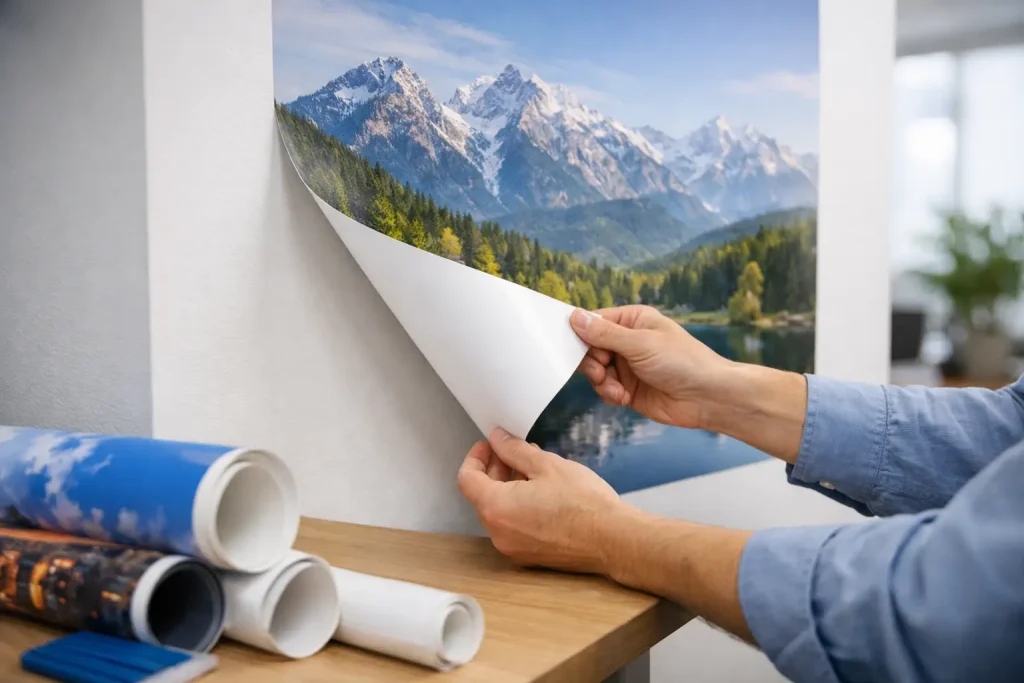
Reusable wall graphics need a different construction. A woven, self-adhesive polyester fabric is designed to lift cleanly, reposition during fitting and be applied again when the project requires it. The fabric remains stable in the hand, so large panels are easier to manage than a thin film that can stretch, crease or fold back on itself.
This makes a genuine operational difference. A shop can retain seasonal graphic panels for next year. An event contractor can move branded messaging from one shell scheme to another. A museum can remove interpretation graphics for access or maintenance, then reinstall them without creating a decorating job. Stick it. Peel it. Reposition it. Re-use it.
That said, reuse is never a reason to ignore site conditions. A wall graphic that has been exposed to grease, moisture, heavy abrasion or airborne dust may not perform as well on its next installation. The aim is repeatable performance, not a promise that every graphic will survive every environment indefinitely.
The material determines whether reuse is realistic
The adhesive layer is only one part of the equation. The face material affects how well a graphic prints, handles, conforms and removes. Fabric media has a practical advantage because its woven construction gives installers control while retaining a refined, non-PVC visual finish.
Phototex is made for applications where clean removal and repeated positioning matter. Its 100% polyester self-adhesive fabric can be lifted and reapplied without leaving adhesive residue or damaging suitable surfaces. That makes it a smarter specification for temporary campaigns, semi-permanent décor and evolving spaces where the wall must remain protected.
Selecting the right version matters just as much as choosing reusable media in the first place. Original is suited to many smooth interior wall applications where a translucent material is appropriate. OPAQUE provides higher opacity and blockout, helping to cover existing colours or graphics and achieve discreet overlaps between panels. For more demanding surfaces, Extra Strength options are designed for textured walls, floors and installations where additional grip is required.
More adhesive is not automatically better. On a smooth, painted interior wall, specifying an unnecessarily aggressive product can work against easy removal. Conversely, a standard adhesive may not be the best choice for a heavily textured surface. Match the media to the substrate, the intended duration and the conditions it will face.
A clean surface protects the next installation
Reusable graphics need a clean contact surface every time they are fitted. Dust, release agents, silicone-based cleaning residues, dampness and loose paint can all affect adhesion. Before installation, ensure the wall is dry, sound and free from contamination. Freshly painted surfaces should be fully cured in line with the paint manufacturer’s guidance.
The graphic itself also deserves protection. If the adhesive side is laid face-down on a dusty floor, dragged across a workbench or pressed against debris during removal, contamination can reduce its ability to bond evenly when reapplied. Good handling is simple, but it is not optional.
How to remove wall graphics for reuse
Removal technique has a direct effect on whether a graphic can be used again. Do not pull sharply from the middle or tear the panel away in short, aggressive movements. Start at a corner, then peel steadily and close to the wall, supporting the material as you go. This reduces stress on both the print and the painted surface.
For larger panels, two installers are often the sensible choice. One person can control the lifted edge while the other supports the released section, preventing it from folding onto itself or touching the floor. This is particularly valuable for exhibition graphics, full-height retail panels and multi-panel murals where alignment must be retained for a later install.
If a graphic has been installed for a long period, or the substrate is delicate, test a small edge first. Paint condition, wall preparation and previous coatings vary widely between sites. A removable material helps reduce risk, but no installer should assume that poorly bonded paint or an unstable surface will behave perfectly.
Keep panels in order
For multi-panel graphics, label the reverse side before removal if it has not already been marked. Record the panel sequence, orientation and intended location. A small amount of organisation can save significant time when the graphic is reinstalled weeks or months later.
Avoid stacking adhesive sides together. They can be protected with clean release liner or stored so the adhesive surface is shielded from dust and contact. Roll panels carefully around a suitable core rather than folding them. Creases may affect the final finish and make alignment harder on the next job.
Storage is part of reusability
A reusable wall graphic is only as reusable as its storage allows. Keep removed panels clean, dry and protected from direct sunlight, excessive heat and heavy weight. A dry, temperature-stable storeroom is preferable to a damp loading area or a vehicle that experiences major temperature swings.
Roll the graphic with care and avoid tight bends. Store it where the edges will not be crushed, as edge damage is often the first issue visible after reinstallation. Where a campaign has several versions or locations, package and label each set separately. This protects the media and gives the next installation team a clear, efficient starting point.
For organisations running recurring campaigns, storage also changes the cost calculation. Instead of printing, shipping and installing an entirely new set of graphics for every activation, teams can retain usable elements and only replace the messages, images or panels that have genuinely changed. That reduces material waste, installation time and pressure on budgets.
When should a wall graphic not be reused?
There are occasions when replacing a graphic is the right decision. If the print has been scratched, the edges are damaged, the adhesive has collected contamination or the design is no longer on-brand, reuse can undermine the finish you are trying to achieve. A premium interior, gallery display or hospitality environment should not compromise on presentation simply because material remains available.
Likewise, do not move a graphic onto a radically different surface without considering adhesion. A panel that performed well on a smooth painted wall may need a different specification for brick-like texture, low-energy paint, a floor or an exterior application. A sample test remains the quickest way to reduce uncertainty before committing to a full installation.
Reuse should be planned at the briefing stage. Confirm where the graphics will go next, how long they will remain installed, who will remove them and where they will be stored. This gives print providers, designers and installers the information to select the right material and finishing approach from the outset.
Reuse creates more freedom for changing spaces
The value of reusable wall graphics is not limited to saving a panel after an event. It gives teams permission to change spaces more often. Retailers can test a visual concept. Venue marketers can refresh a corridor for a new season. Fit-out teams can protect walls while displaying project information, then return the surface cleanly when the work is complete.
That flexibility supports a more responsible approach to graphics too. Materials are used for longer, fewer surfaces need repairing after removal, and campaigns can be adapted rather than automatically discarded. For professional environments where speed, finish quality and substrate protection all matter, that is a practical advantage worth specifying from the first brief.
Choose a material designed to lift cleanly, handle it carefully and store it properly. Then the next campaign, relocation or room refresh starts with graphics ready to work again.
 English
 French