
A wall graphic should not become a redecorating problem. For retail teams changing campaigns, exhibition contractors working to tight handover times, or facilities managers protecting valuable finishes, a guide to printable fabric wall media starts with one requirement: the material must look exceptional while coming away cleanly when the job is done.
Printable self-adhesive fabric provides a modern alternative to conventional PVC wallcoverings and permanent adhesives. It is designed to stick, peel, remove, reposition and re-use, giving professional users greater control over installation, campaign changes and lifecycle cost. The result is high-impact wall décor and display graphics without the familiar risks of residue, torn paint, curling edges or labour-intensive removal.
What Printable Fabric Wall Media Does Differently
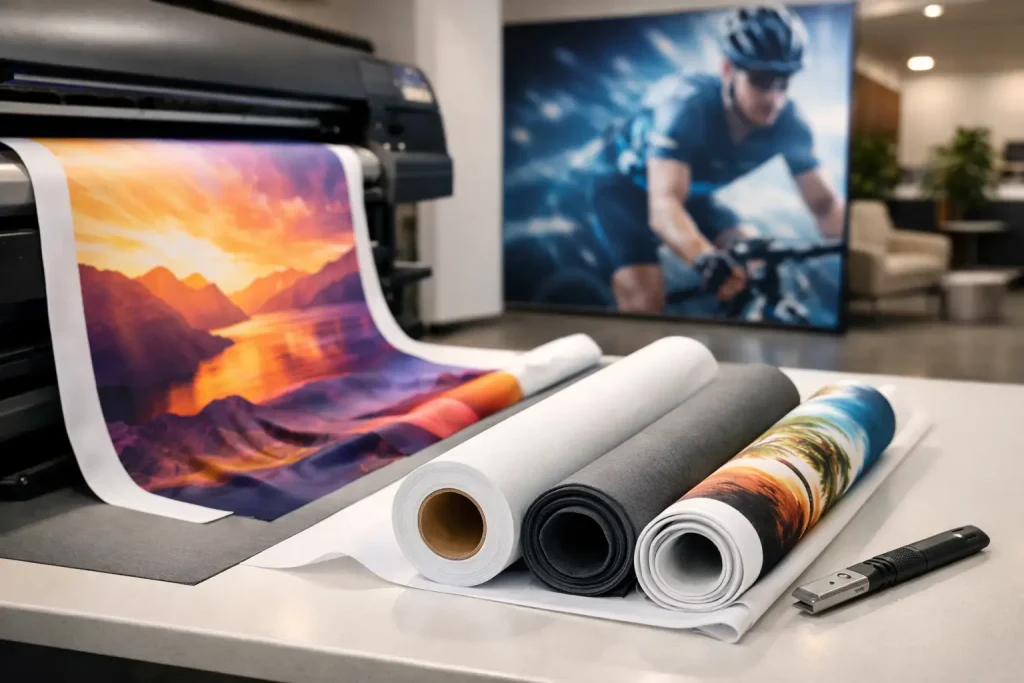
Printable fabric wall media is a woven polyester material with a pressure-sensitive adhesive backing. Once printed, it becomes a tactile graphic surface for walls, displays, interiors, windows, ceilings and selected floor or textured applications. Unlike rigid panels, it can be supplied in manageable sections. Unlike traditional pasted wallpaper, it does not require wet adhesive, booking time or extensive clean-up.
The difference is most apparent at the end of a project. Vinyl graphics and low-grade adhesive films can leave glue behind, lift paint, shrink over time or demand costly remedial work. A quality peel-and-stick fabric is engineered to remove cleanly from suitable prepared surfaces. That makes it a practical choice wherever the substrate matters as much as the graphic.
For a museum, that may mean protecting a painted gallery wall. For a hotel, it may mean refreshing a corridor between bookings. For a retailer, it means changing a seasonal launch overnight rather than closing an area for redecoration. The material is not simply a print surface. It is a more flexible way to manage space.
Choosing the Right Printable Fabric Wall Media
The correct specification depends on the surface, the viewing conditions, the graphic design and how long the installation needs to remain in place. Choosing on price alone can create avoidable installation risk, particularly on difficult walls or dark backgrounds.
Original fabric for standard wall graphics
A translucent printable fabric is well suited to smooth, clean, painted walls and many indoor décor applications. It offers excellent print quality and a natural fabric finish, making it effective for photo murals, branded interiors, exhibition panels and short-to-medium-term promotional graphics.
Its translucency is useful when the wall colour is light and consistent. However, it may not be the right choice over bold paint colours, existing graphics or contrasting panels, where the underlying surface can influence the appearance of the print.
Opaque fabric for blockout and invisible overlaps
Where colour consistency and coverage are critical, opaque media is the stronger option. Its blockout layer reduces show-through from the wall beneath, helping colours retain their intended impact. It is particularly valuable for retail roll-outs, corporate interiors, large murals and any project installed over a varied or darker substrate.
Opaque media also supports cleaner panel joins. In many designs, sections can overlap without the overlap line showing through, creating a more continuous finished image. This saves time on site and reduces the precision pressure associated with butt-joining wide wallcovering panels.
Extra-strength media for demanding surfaces
Not every wall is smooth, sealed and straightforward. Textured paint, brick-effect finishes, difficult interior surfaces, floors and more demanding indoor or outdoor applications may require an extra-strength adhesive system. This is where testing is essential.
Extra strength improves grip, but it should never be treated as a substitute for surface assessment. A heavily textured, dusty, damp, flaking or recently painted surface can affect every self-adhesive material. Specify according to the substrate, not just the visual ambition of the project.
Start with the Surface, Not the Artwork
The most successful installations are planned before the file reaches print. Inspect the wall for dust, grease, silicone, loose paint, moisture, uneven texture and fresh coatings. Fresh paint needs sufficient curing time, while walls cleaned with chemical products should be fully dry and free from residue.
A simple sample application can prevent a costly failure on a full site installation. Apply a test piece to the intended surface, leave it in place, then assess adhesion, removability and any interaction with the coating. This matters especially in heritage settings, leased premises, childcare environments and high-traffic venues where surface protection is non-negotiable.
Temperature also affects application. Very cold materials can be less compliant, while excessively hot surfaces may change adhesive behaviour. Bring rolls into the installation environment where possible and allow them to acclimatise. A stable, clean, dry substrate creates the best conditions for a long-lasting finish.
Print for the Finish You Want on the Wall
Fabric media can reproduce photography, illustrations, brand colour and fine detail with impressive depth, but the print workflow must be controlled. Use the relevant ICC profile for the printer and ink set, then test critical colours before committing to a full production run. This is particularly important for brand palettes, skin tones, archival imagery and colour-matched retail graphics.
Allow prints to dry and outgas as appropriate for the ink technology before finishing or installation. Rushing this stage can affect handling and final appearance. Keep cutting accurate, especially where patterns, lettering or tiled murals need to align across multiple panels.
Think about panel layout at artwork stage. Place joins away from faces, key typography and high-contrast visual features where possible. Build in sensible overlap where the material and application call for it. A wall graphic is judged from normal viewing distance, but small planning decisions can determine whether it reads as one confident image or a sequence of separate printed strips.
Installation: Controlled, Clean and Repositionable
One of the strongest commercial advantages of printable fabric media is that it reduces installation complexity. There is no paste table, no soaking and no need to manage wet paper expansion. Still, professional technique remains important.
Begin with a plumb vertical reference line rather than relying on the wall edge, which may not be true. Position the first panel carefully, peel back only a manageable section of liner and apply from the centre outward using a soft applicator. Work gradually to avoid trapping air and to keep the graphic aligned.
If a panel is not right, peel it back gently and reposition it. That recoverability is a practical safeguard during fitting, especially with large murals, busy live venues and fast-paced event builds. It also makes later updates possible without replacing the entire decorative scheme.
Avoid stretching the material during application. Stretching can distort printed elements and compromise alignment at panel joins. On textured surfaces, use the recommended method and pressure for the chosen media so the adhesive makes consistent contact with the substrate.
Where Fabric Wall Media Earns Its Keep
The value of this material is clearest in projects that change regularly or cannot tolerate substrate damage. Retail teams can install campaign graphics, remove them after promotion and prepare the space for the next launch. Exhibition contractors can transform shell schemes, galleries and feature walls with lighter, easier-to-handle graphics than rigid alternatives.
Interior designers and hospitality teams can create temporary room transformations, feature walls and branded wayfinding without committing clients to permanent wallcoverings. Museums and heritage organisations can use removable interpretation graphics where preservation standards make conventional adhesives unsuitable. In offices, it is an efficient route to culture walls, meeting-room graphics and project-specific branding.
It also has a sustainability dimension. Repositionability reduces waste caused by installation errors. Re-use can extend the working life of certain graphics where they are carefully removed, stored and reapplied. Clean removal can avoid painting, patching and replacing damaged finishes. The best environmental choice still depends on the project, but reducing single-use materials and unnecessary refurbishment is a meaningful operational gain.
Removal and Re-use Need the Same Care as Installation
Removal is straightforward, but it should not be rushed. Start at a corner and peel slowly at a low angle, keeping the material close to the wall rather than pulling sharply away from it. This controlled method supports clean release and protects both the graphic and the surface.
Where a graphic will be re-used, keep it clean during removal and retain the liner for storage if possible. Roll or store panels carefully to prevent creasing, contamination and damage to the adhesive. Re-use is dependent on surface conditions, handling and the length of the original installation, so it should be treated as a capability to plan for rather than an assumption on every job.
Phototex gives print providers, installers and venue teams a dependable material platform for this kind of work: woven polyester fabric, residue-free removal on suitable surfaces, repeat repositioning and options for standard, opaque and demanding applications.
The strongest wall graphics do more than fill a blank space. They give teams permission to change the space again, quickly and confidently, without leaving a costly trace behind.
 English
 French