
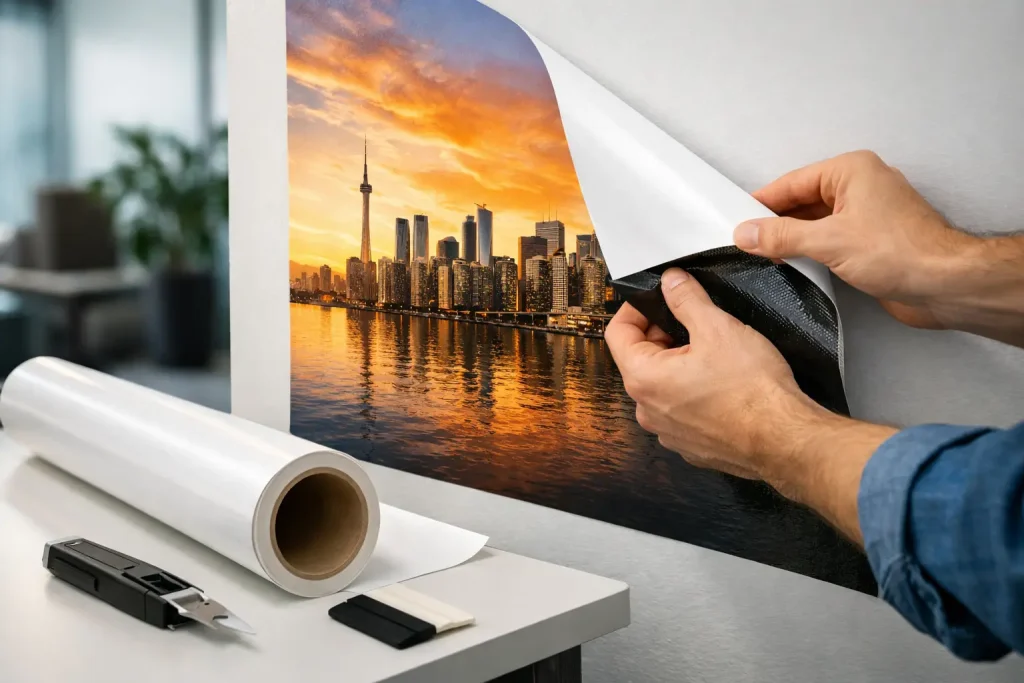
A wall graphic only looks premium if the surface underneath stops interfering with the result. Old paint lines, bold wall colours, patched areas and overlapping panels can all show through a standard material and flatten the impact of the print. That is exactly where high opacity printable wall film earns its place. It gives specifiers, printers and installers stronger visual control, especially when the job demands sharp colour, solid coverage and a finish that can be changed without creating a decorating bill afterwards.
For commercial interiors, exhibitions, retail campaigns and branded environments, opacity is not a minor detail. It affects whether a graphic reads cleanly from the first metre away, whether panel joins remain discreet, and whether the installation still looks right under difficult venue lighting. If the brief includes temporary or changeable graphics, the material also has to remove cleanly and protect the wall beneath. That is where a fabric-based solution changes the conversation.
What high opacity printable wall film actually does
At its simplest, high opacity printable wall film is designed to block the background. Instead of letting the wall colour, texture variation or previous graphics influence the printed image, it creates a stronger visual barrier between the substrate and the print. That matters on painted plaster, exhibition panels, retail feature walls, museum displays and any site where the existing finish is less than perfect.
High opacity becomes especially valuable when one panel needs to overlap another. With lower opacity media, overlap zones can darken or show a visible edge, which is a problem on large murals, campaign graphics and tiled installations. A more opaque construction helps create invisible overlaps, so the finished wall reads as one image rather than a set of joined pieces.
This is also why opacity should not be treated as a purely aesthetic specification. It has operational value. Better blockout means less time trying to compensate in the artwork, fewer compromises on where graphics can be installed, and less risk of the final result looking washed out or uneven.
Why high opacity printable wall film matters on real projects
On site, perfect walls are rare. Retail spaces are refreshed quickly. Exhibition builds are reused. Hospitality interiors face wear, repainting and patch repairs. Heritage and public venues often need graphics that work around sensitive or inconsistent surfaces. In those conditions, material choice decides whether the job stays efficient or starts absorbing labour.
A high opacity printable wall film gives more freedom because the wall does not need to be visually perfect before installation. That does not remove the need for sensible surface preparation, but it does reduce the chances of the substrate spoiling the print. For installers, that means more predictable results. For specifiers, it means fewer restrictions when selecting locations for campaigns, wayfinding or decorative features.
There is also a commercial benefit in repeat-change environments. If a venue rotates messaging, promotions or seasonal décor, the best result comes from a material that combines opacity with residue-free removability. Strong visual coverage is only half the job. The other half is being able to peel it away without damaging paintwork, leaving adhesive behind or turning a simple refresh into a maintenance issue.
The difference between standard wall media and opaque fabric media
Not every printable wall product behaves the same way, even if the application sounds similar on paper. Traditional PVC-based wallcoverings can offer strong graphics, but they often bring trade-offs around installation time, handling, environmental profile and removal risk. Lower opacity self-adhesive films may be fine on bright white, uniform surfaces, but can quickly show their limits on darker walls or where panel matching matters.
A woven polyester adhesive fabric with a high opacity layer approaches the problem differently. It is built for print performance, but also for easier handling and cleaner removal. That combination is what makes it useful across interiors, events and display environments where graphics need to look finished on day one and come away cleanly later.
Phototex OPAQUE is a good example of where this specification makes practical sense. It is designed for high blockout and invisible overlaps, while keeping the wider benefits of a peel-and-stick fabric media – residue-free removal, repositionability and surface protection. For trade users, that means fewer compromises between visual performance and operational flexibility.
Where a high opacity printable wall film performs best
Retail is one of the clearest use cases. Campaign walls often sit over coloured paint, previous display zones or surfaces that have been refreshed in stages. A high opacity material holds colour density and prevents the wall underneath from weakening the message. It also makes late campaign changes less painful.
In exhibitions and events, install speed and removal standards matter as much as print quality. Contractors need a material that can be positioned accurately, adjusted if needed, and removed without leaving the shell scheme or venue wall in poor condition. A high opacity printable wall film helps graphics look complete under event lighting, while a fabric construction reduces some of the handling frustrations associated with stiffer alternatives.
Interior designers and fit-out teams also benefit when decorative graphics need to cover inconsistent backgrounds without adding a long, disruptive installation process. In museums, galleries and heritage spaces, the requirement is often even stricter. The surface must be respected, the finish must be clean, and the graphic may need to be removed or updated without trace. In those projects, the right adhesive behaviour is as important as the opacity itself.
What to look for beyond opacity
Opacity matters, but it should not be specified in isolation. A material can block out the wall and still create problems if it is difficult to install, prone to edge lift, or aggressive on removal. The better question is whether the product solves the full lifecycle of the graphic.
First, consider repositionability. Large wall graphics rarely go on perfectly in one movement, especially across mixed site conditions. A material that allows repeated repositioning reduces waste and lowers install risk. Second, consider removability. If the campaign, exhibition or décor scheme is temporary, clean peel performance protects both the wall and the project budget.
Print providers should also think about finish consistency and overlap behaviour. If the design spans multiple drops, invisible joins can make the difference between a graphic that looks bespoke and one that looks pieced together. Add sustainability to that decision, and fabric media has a clear advantage for organisations trying to move away from less responsible, harder-to-handle alternatives.
Choosing the right high opacity printable wall film for the substrate
It depends on the surface. Smooth painted walls, standard interior boards and many display panels are usually straightforward. More textured walls or demanding indoor and outdoor conditions may need an extra strength option. That is why substrate testing still matters, even with a forgiving fabric media.
The smart approach is to match the specification to the wall, the duration of the installation and the removal expectation. A short-term retail promotion has different demands from a semi-permanent hospitality feature wall. A museum panel system differs from a high-traffic event environment. The material should support the brief, not force the brief to adapt.
This is where technical support matters. ICC profiles, application guidance, cutting recommendations and sample testing all reduce uncertainty before the job reaches site. For trade customers, that preparation is not a nice extra. It is part of delivering repeatable, profitable installs.
High opacity printable wall film and total project efficiency
The cheapest media on the quote sheet is rarely the cheapest route through the job. If a material takes longer to install, cannot be repositioned, shows through at the joins or damages the wall on removal, the hidden cost appears later in labour, snagging and redecoration. Professional buyers already know that material performance affects the whole schedule.
A high opacity printable wall film earns value by reducing those failure points. It gives stronger print impact on imperfect surfaces, supports cleaner overlaps, shortens decision time on site and helps protect the substrate when the graphic comes down. That is good for installers, good for facilities teams and good for clients who want campaigns and décor changes without disruption.
The better wall graphic materials do more than carry ink. They protect surfaces, simplify fitting, support reuse and make change easier. If your next project needs strong blockout, premium finish quality and the confidence of clean removal, choose a product that does the whole job properly – then stick it, peel it, reposition it and use the wall again with confidence.
 English
 French