
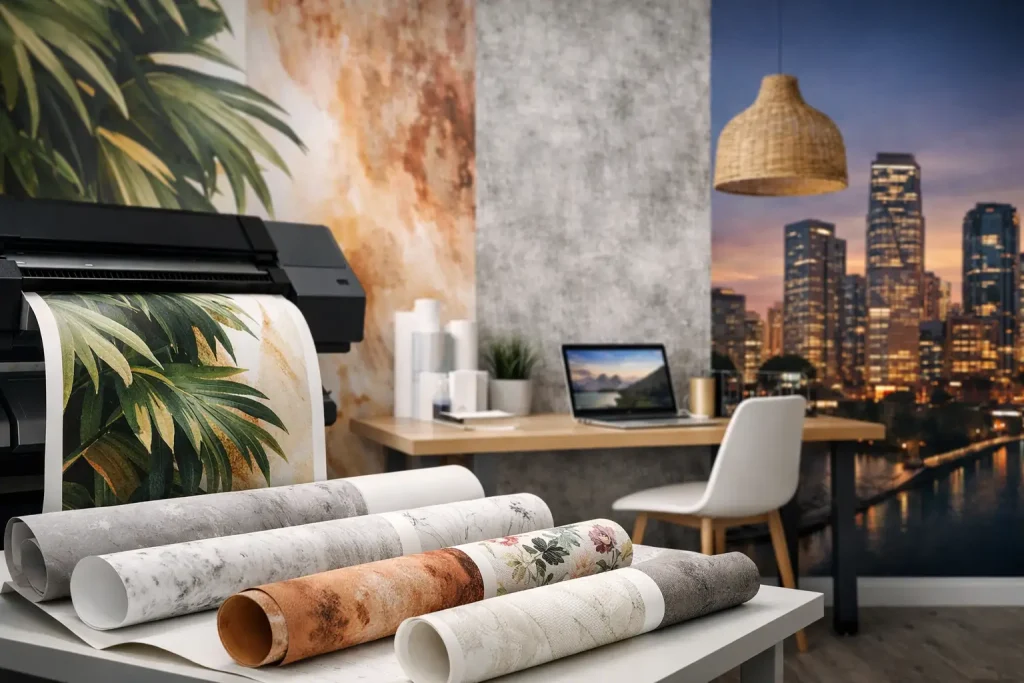
A retail campaign changes overnight. A gallery needs exhibition graphics removed without touching protected paint. A hotel wants a room refresh without closing floors for messy decorating. In each case, printable wall coverings need to do more than look good on day one. They need to install quickly, hold reliably, remove cleanly and leave the surface ready for what comes next.
That is where material choice changes the economics of a project. Traditional wallpaper and self-adhesive PVC vinyl can produce impressive graphics, but they often bring avoidable risk: difficult positioning, visible joins, wall damage, adhesive residue and costly remedial work. A printable fabric media designed for clean removal gives print providers, installers and facilities teams a more flexible route.
What professional printable wall coverings should deliver
For commercial interiors, wall graphics are rarely permanent in the truest sense. Brands refresh promotions, venues rotate programming and occupiers change spaces. Even a long-term installation may eventually need to be removed with minimal disruption. The right printable wall covering should therefore be judged across its full lifecycle, not simply by initial print quality or square-metre price.
First, it must accept high-quality print and deliver the colour, detail and texture expected in retail, hospitality, exhibition and interior schemes. Secondly, it needs to be manageable on site. A material that can be repositioned during fitting gives installers more control around architectural details, panels, corners and alignment. Finally, removal matters. If a graphic leaves adhesive behind, pulls paint away or requires hours of scraping, a supposedly economical product becomes expensive very quickly.
Fabric-based peel-and-stick media offers a practical answer because its woven structure brings a softer, more premium finish than many smooth plastic films. It is also more forgiving during application. Rather than committing to the first placement, the installer can lift, adjust and reapply where necessary. Stick it. Peel it. Reposition it. Remove it. That working flexibility is valuable on every site where time, access and finish quality matter.
Why removable fabric changes the project calculation
The cost of wall graphics is not just the material and print. It includes surveying, preparation, installation time, access equipment, removal, cleaning and possible redecoration. This is particularly relevant in leased offices, listed buildings, museums, schools, hospitality venues and busy retail environments, where the substrate may be sensitive or difficult to repair.
A residue-free, peel-and-stick printable fabric can reduce that downstream risk. When correctly matched to the surface and applied in suitable conditions, it is designed to lift away cleanly without damaging the wall beneath. That protects the client’s asset and reduces the likelihood of an awkward handover conversation at the end of an activation, event or tenancy.
Reusability can also affect the value calculation. Exhibition panels, directional graphics, temporary branding and seasonal displays do not always have to be discarded after one use. If removed carefully and kept clean, suitable fabric graphics can be retained for future use. This is not a reason to treat every installation as endlessly reusable – handling, storage, surface condition and graphic complexity all matter – but it creates an option that conventional pasted wallpaper does not provide.
There is a sustainability benefit too. Avoiding damaged walls means fewer repairs, less paint and less material waste. Reusing viable graphics can reduce the need for repeat production. For organisations trying to improve the environmental performance of fit-outs and campaigns, choosing a durable, removable media is a practical decision rather than a cosmetic claim.
Selecting printable wall coverings for the surface
No single product is the right answer for every wall. Surface texture, paint condition, humidity, expected dwell time and the demands of the application should shape the specification. A smooth painted wall in a workplace has very different requirements from a brick-effect retail feature wall, an external display or a temporary floor graphic.
For smooth interior walls and general décor, a standard self-adhesive fabric media can provide dependable adhesion, a tactile finish and straightforward removal. Translucent options can work well where the base surface is uniform and overlaps are acceptable within the design.
Where dark colours, existing graphics or strong wall colours could show through, an opaque or blockout printable wall covering is often the better choice. High opacity helps create denser colour and supports invisible overlaps, making it particularly useful for large murals, branded backdrops and installations where visual continuity is critical.
More demanding surfaces need more grip. Textured walls, challenging substrates, floors and certain indoor or outdoor applications may require an extra-strength adhesive option. The goal is not simply maximum tack. It is the appropriate balance of adhesion, removability and surface protection for the job. Specifying too lightly can lead to edge lift or failure; specifying without considering the substrate can create unnecessary removal risk.
A small site test remains good practice, especially on newly painted walls, delicate finishes, unknown paint systems, low-energy coatings or heritage surfaces. Test the proposed material on the actual substrate, allow it to dwell, then assess adhesion and removal. This modest step can prevent expensive assumptions from becoming site problems.
Print, cut and install with the finish in mind
Great wall graphics begin before the installer reaches site. Use the correct printer settings and ICC profile for the selected material, then allow prints to dry and stabilise as required by the ink system. Colour consistency matters across tiled mural panels, particularly where gradients, skin tones or brand colours run through joins.
Plan panel widths around the wall dimensions, access constraints and the installer’s working method. A well-considered panel plan reduces handling, makes alignment easier and avoids narrow final strips that can look like an afterthought. Bleed, trim marks and cutting accuracy should be agreed before production, not improvised on site.
Surface preparation should be simple but disciplined. The wall needs to be dry, sound and free from dust, grease and loose paint. Freshly painted surfaces need adequate curing time according to the paint manufacturer’s guidance. Fabric wall media can be forgiving during placement, but no self-adhesive product can compensate for a weak or contaminated substrate.
During fitting, begin with a true vertical reference and work steadily from the top down. Use light, even pressure to secure the graphic without stretching it. If alignment drifts, lift and reposition rather than forcing the material into place. The ability to correct placement is one of the main operational advantages, so use it.
Where fabric wall graphics earn their place
The strongest applications are those where visual impact and future flexibility are equally important. Retail teams can change campaign walls without building a redecoration budget into every launch. Exhibition contractors can install branded environments quickly, then remove graphics at the end of the show. Interior designers can introduce bespoke art, wayfinding and feature walls without committing a client to permanent wallpaper.
Museums, galleries and heritage venues have an additional reason to specify carefully. Their surfaces may be protected, historic or simply too valuable to risk. A clean-removable fabric graphic allows interpretation, temporary displays and visitor information to sit alongside the building rather than becoming a threat to it.
Hospitality and workplace projects benefit from the same flexibility. Bedrooms, meeting rooms, reception spaces and communal areas can be refreshed around seasonality, a refurbishment programme or a changing tenant identity. For facilities teams, clean removal means fewer out-of-hours repairs and a quicker return to service.
Phototex is designed around this material-first approach: a woven 100% polyester self-adhesive fabric that can be printed for décor, display and surface graphics, then removed cleanly when the project changes. With Original, OPAQUE and EX options, the specification can follow the application rather than forcing every wall into one product choice.
Avoid the common specification mistakes
The most frequent error is treating every wall as identical. A photo of a painted surface does not reveal whether the paint is sound, whether the wall has texture, or whether cleaning products have left a residue. Surveying the substrate and testing where appropriate is far more reliable than selecting on appearance alone.
Another mistake is focusing solely on purchase cost. A cheaper film that takes longer to install, cannot be repositioned or causes damage on removal may cost substantially more over the life of the project. Labour, disruption and making-good should be considered from the start.
Finally, do not overlook the design itself. Dark graphics over dark substrates, large continuous imagery and close-viewed murals demand the right opacity, panel planning and print control. The best material in the wrong specification cannot deliver the finish the client expects.
Choose printable wall coverings as part of the whole installation plan: surface, print method, design, expected lifespan and removal route. When those decisions are made together, walls can become high-impact communication space without becoming a future repair job.
 English
 French