
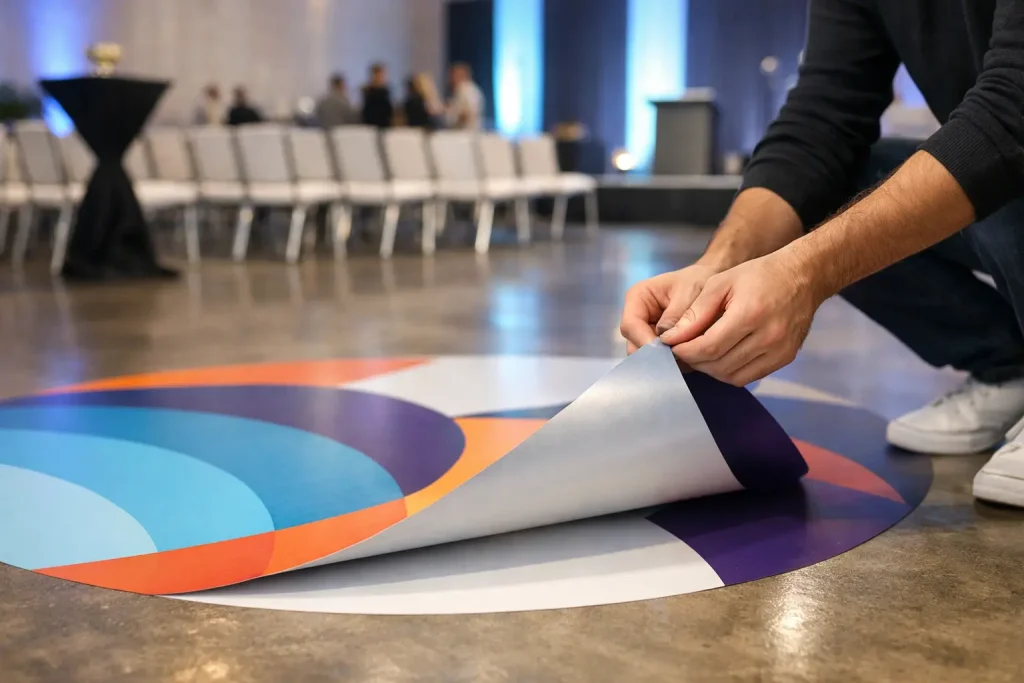
When an event floor has to work hard, it usually gets asked to do three jobs at once – direct footfall, carry branding, and come away cleanly when the show is over. That is exactly where removable floor graphics for events earn their place. For exhibition halls, conference venues, museums, retail activations and hospitality spaces, the right floor media is not just about print quality. It is about installation speed, safety, surface protection and the ability to remove graphics without turning a fast turnaround into a repair project.
Why removable floor graphics for events matter
Event environments are rarely gentle. Floors deal with foot traffic, trolleys, cleaning routines, changing layouts and tight build schedules. Traditional adhesive graphics can look acceptable on day one, then become a problem at breakdown – lifting poorly, leaving adhesive behind, or pulling at the finish of the substrate beneath.
That failure point is expensive. Facilities teams do not want residue on sealed floors. Contractors do not want extra labour scraping adhesive after a de-rig. Brand teams do not want a premium activation undermined by curled edges or tired-looking graphics halfway through a campaign. A removable solution changes the commercial equation because it reduces risk before the event starts, not after something goes wrong.
For professional users, that matters more than a headline price per square metre. If the media installs quickly, stays in place, and removes cleanly, the total job cost often looks very different.
What good event floor media actually needs to do
A floor graphic at an event is not the same as a wall graphic moved onto a horizontal surface. It has to perform under pressure. That means the media needs strong adhesion for the intended substrate and traffic level, but it also needs controlled removability. Those two requirements can appear to conflict, yet both are essential.
The best-performing products also need to print well, lie flat, and handle repositioning during installation. On a busy site, that flexibility saves time. Installers rarely get perfect conditions. There may be last-minute stand changes, misalignment on branded routes, or a venue insisting on revised positioning once build has begun. A media that can be lifted and reapplied without damage is a practical advantage, not a nice extra.
Surface protection is another factor that gets overlooked until a venue starts asking questions. In heritage, museum, hospitality and premium commercial spaces, the substrate itself matters. If a removable graphic can help protect the finish beneath while delivering the visual message on top, it supports both presentation and compliance.
Where removable floor graphics are most effective
Events use floor graphics in different ways, and the best specifications reflect that. Wayfinding is the obvious one. Entrance routes, registration flows, queue systems and directional paths all benefit from graphics that can be installed quickly and removed just as fast when the venue returns to normal use.
Branding is another strong use case. Floor space is often underused, yet it is one of the few surfaces guaranteed to be seen. At exhibitions and pop-up activations, floor graphics can extend stand design, reinforce sponsors, or create immersive zones without the cost and weight of more built structures.
They also work well for temporary zoning. Seminar areas, kids’ activity spaces, demo points and social photo spots all need visual boundaries. Graphics can define these areas clearly without permanent alteration to the venue. For event teams working across multiple dates and layouts, that flexibility is hard to beat.
The trade-off between grip, removability and reuse
Not every event floor graphic has the same brief. Some are needed for a single weekend on a straightforward sealed floor. Others must last through a longer campaign, cope with heavier traffic, or sit on a more demanding surface. This is where specification matters.
If the adhesive is too aggressive, removal becomes the problem. If it is too light for the substrate or traffic level, the graphic may fail during use. The right answer depends on the floor finish, expected wear, installation time available and whether the graphic needs to be repositioned or reused.
That is why material-first thinking is more reliable than choosing on price alone. A printable fabric media with residue-free removability and the ability to reposition repeatedly gives contractors far more control than standard film products that are less forgiving once applied. For event work, that control often means fewer failures, less waste and better use of labour.
Fabric media versus traditional vinyl on event floors
This is where the comparison becomes practical. Traditional vinyl has long been used in short-term graphics, but it brings familiar issues. It can be less forgiving to install, more prone to leaving adhesive residue, and more likely to create substrate concerns when removed from sensitive finishes. Once you add the pressure of overnight builds and rapid breakdowns, those weaknesses show up quickly.
A woven polyester self-adhesive fabric offers a different proposition. It is easier to handle, more forgiving during installation and designed for clean removal. That makes it particularly useful for venues that host multiple events and need surfaces turned around fast without damage. It also supports sustainability goals more convincingly than products that are effectively single-use and labour-heavy at removal.
For professionals specifying graphics across exhibitions, conference spaces and branded environments, the point is not novelty. It is reliability. A smarter material reduces installation risk and protects the client relationship.
Choosing the right removable floor graphics for events
The first question is always the surface. Smooth, sealed internal floors are very different from textured or more challenging substrates. The second is traffic. A quiet hospitality lounge and a busy exhibition aisle do not place the same demands on the media. The third is duration. A one-day event allows more options than a week-long activation with continuous footfall.
Print providers and installers should also consider finish quality and opacity. If there are existing markings or strong substrate colours below, show-through can compromise the result. In those cases, a higher-opacity option can deliver a cleaner visual finish. For more demanding floor applications, extra-strength variants are often the better choice because they are built for tougher environments without losing the advantage of removability.
This is also the stage to think about future use. If a campaign may travel, repeat, or require short-term repositioning between venues, reusability becomes commercially valuable. A media that can be removed and used again where appropriate helps reduce waste and lowers the cost of recurring activations.
Installation efficiency is part of the value
Event graphics are often judged on appearance, but the install process is where costs rise or fall. A product that is quick to align, simple to trim and easy to reposition reduces pressure on site teams. That matters on overnight builds, in venues with restricted access, and in projects where several trades are competing for the same timetable.
Clean handling also supports better results. Fabric media avoids some of the awkwardness associated with stiffer alternatives, especially at larger panel sizes. If the installer can place, lift, adjust and finish the job without fighting the material, quality improves and labour time usually drops.
For agencies and contractors, that translates into fewer snags and more predictable delivery. For venues and facilities teams, it means less disruption and lower risk to the floor beneath.
Clean removal is not a small detail
At the end of an event, everyone is in a hurry. That is exactly when poor material choices become obvious. Graphics that leave residue create extra cleaning time, delay handover and can trigger disputes about damage. Even when the residue can be removed, it adds labour and introduces another chance to affect the floor finish.
A residue-free removable media changes that end-of-project experience completely. Peel it away, leave the surface clean, and move on. That is not just a convenience. It protects margins, preserves venue relationships and supports repeat business.
This is one reason products such as Phototex continue to appeal across exhibitions, retail, heritage and commercial interiors. The combination of print performance, repositionability, substrate safety and clean removal solves real operational problems, not theoretical ones.
Sustainability has to include the whole job
Event buyers are under pressure to reduce waste, but sustainability claims only stand up when they reflect the full lifecycle of the graphic. If a material is easy to install, reusable in the right circumstances, and removes without chemical-heavy cleanup or surface repair, the environmental case is stronger.
That wider view matters. A graphic that damages the floor beneath may force repainting, recoating or replacement work after the event. A supposedly cheaper product can therefore create more material use, more labour and more disruption overall. Choosing a removable fabric system is often the more responsible option because it reduces waste at several points, not just in the print stage.
For event professionals, the best floor graphic is not the one that simply sticks. It is the one that performs on site, protects the surface, comes away cleanly and keeps the next project easy to deliver. If your venue, client or campaign needs flexibility without compromise, start with the material – the rest of the job gets simpler from there.
 English
 French