
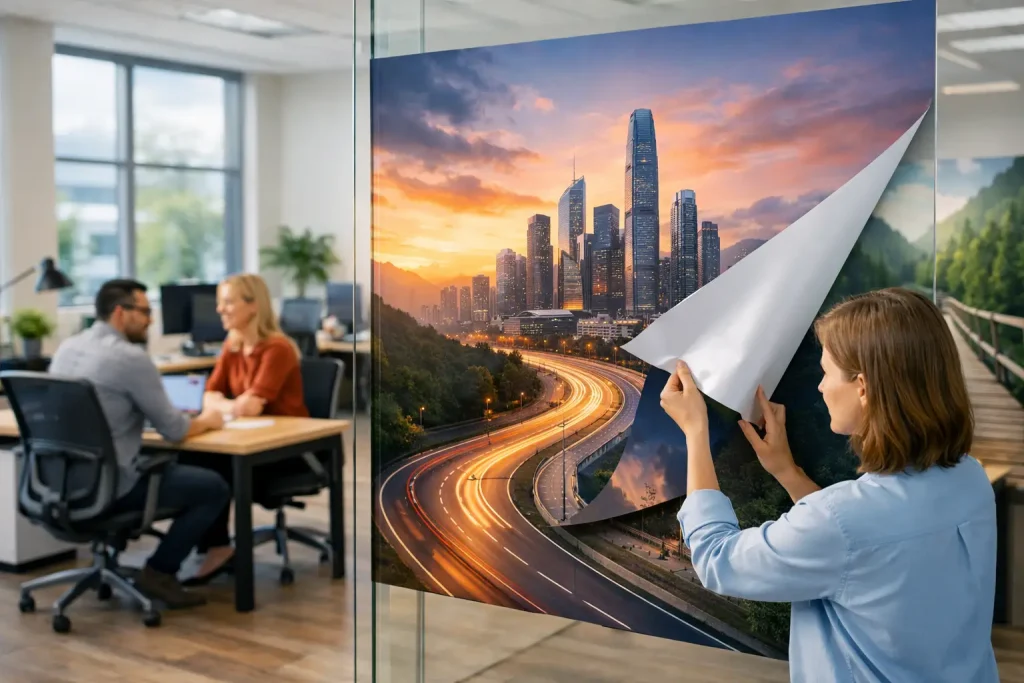
Office graphics usually look easy at concept stage. Then reality turns up – painted plasterboard, tight programme dates, live working areas, rebrands, landlord restrictions, and the very real cost of putting walls right afterwards. That is exactly why removable wall graphics for offices have moved from a nice visual extra to a serious specification choice. For print providers, designers, facilities teams and fit-out specialists, the question is no longer whether wall graphics can transform a space. It is whether they can do it without creating a problem later.
The answer depends less on artwork and more on material performance. If the graphic needs to install quickly, sit flat, reposition during fitting, protect the surface, and remove cleanly when the campaign or décor changes, the media matters as much as the design.
Why removable wall graphics for offices are now a practical requirement
Modern offices change faster than the buildings they occupy. A space may need to support employer branding this quarter, recruitment next quarter, then a departmental move, seasonal campaign or client event after that. Permanent wallcoverings and standard self-adhesive vinyl often struggle in that environment because they were not designed for repeated change with minimal disruption.
That is where removable fabric-based graphics stand apart. They give specifiers a way to add colour, messaging, privacy features and visual interest without locking the client into expensive future remedial work. In commercial terms, that changes the whole lifecycle cost of the project. A cheaper material that damages paint, leaves adhesive behind or requires lengthy labour to strip off is rarely cheaper by the end.
There is also a risk issue. Facilities managers and landlords are understandably wary of anything that might lift paint, mark walls or trigger redecoration across occupied floors. A removable system with a proven residue-free performance is not just convenient – it reduces uncertainty.
What offices actually need from wall graphics
Office environments are varied, but the practical brief is surprisingly consistent. Graphics need to look sharp, install with speed, and cope with the reality of interior surfaces that are rarely perfect. Smooth painted walls, glass, doors, panels and even some textured surfaces may all appear within one project. Add in phased installation and late artwork changes, and a rigid one-shot material can quickly become a liability.
A more dependable solution is a woven polyester self-adhesive fabric that can be peeled, repositioned and removed without leaving residue. That combination solves several site problems in one go. Installers gain more control during application. Designers gain freedom to create larger visual pieces without building in future damage costs. End users gain the flexibility to refresh interiors as often as they need.
The performance difference is especially obvious in live office settings. Nobody wants prolonged closure of meeting rooms or noisy preparation works in open-plan areas. A peel-and-stick fabric graphic can shorten fitting time, reduce disruption and avoid the mess associated with more aggressive adhesives.
Where removable graphics add the most value in offices
The obvious application is branding – reception areas, client suites, corridors and breakout spaces. Yet the strongest office schemes usually go further than a logo wall. Graphics can support culture, reinforce values, improve navigation and help create distinct zones across larger workplaces.
In meeting rooms, removable wall graphics can soften hard interiors and bring privacy or thematic identity without committing the client to a permanent finish. In collaboration spaces, they can introduce colour and energy where the base build feels generic. In circulation areas, they can carry wayfinding, campaign messaging or heritage storytelling. For serviced offices and flexible workspaces, they are particularly useful because interiors must adapt quickly between tenants and events.
There is also a strong protective argument. A quality self-adhesive fabric does not simply decorate a wall; it can help shield the substrate beneath from scuffs and everyday wear. That matters in high-traffic zones where repainting is disruptive and costly.
The trade-off with traditional vinyl and wallcoverings
Not every office job needs the same level of removability, and there are cases where a more permanent finish is acceptable. But if change is likely, standard vinyl and conventional wallpaper systems often bring compromises that specifiers know too well.
One issue is application tolerance. Some products are less forgiving during install, especially on larger panels or where walls are imperfect. Another is removal. Adhesive residue, paint lift and surface marking can turn a straightforward deinstallation into a maintenance problem. Even when the graphic itself performs well visually, the aftercare cost can undo the initial value.
This is where a residue-free removable fabric media offers a smarter route. It is not just about taking the graphic down. It is about taking it down cleanly, without introducing snagging work for decorators, contractors or in-house teams. That difference matters on repeat campaigns, short-term occupancies and landlord-sensitive sites.
Choosing the right removable wall graphics for offices
Specification should start with the wall and the use case, not only the print face. Smooth painted surfaces may suit a standard removable fabric, while darker existing graphics or strong background colours may call for a higher opacity option to improve coverage and visual consistency. If the wall is more demanding, such as lightly textured or exposed to heavier wear, extra-strength variants may be the safer choice.
Opacity is often overlooked until late in the process. In office refurbishments, it can be the detail that prevents show-through and allows cleaner panel overlaps. That means a more convincing finished look with less compromise in colour density.
Repositionability is another feature that pays for itself quickly. On a busy fit-out programme, even skilled installers benefit from a media that can be lifted and reset without losing performance. It reduces waste, protects the finish, and gives teams more confidence when applying larger graphics at pace.
Phototex has built its reputation on exactly that combination – peel-and-stick printable fabric media that removes cleanly, repositions repeatedly and protects the surface underneath. For professional users, that is not a gimmick. It is a practical answer to common site risks.
Installation efficiency is part of the value
Office graphics are often assessed on print quality and visual impact, but installation efficiency deserves equal weight. Labour is a major cost line, and every avoidable complication on site has a price. Materials that need excessive preparation, specialist handling or difficult removal can make a project less profitable even when the print itself looks good.
A removable woven fabric media helps keep the process under control. It is easier to handle than many alternatives, straightforward to trim, and forgiving enough to support accurate placement. That can be the difference between a smooth overnight install and a delayed handover.
For print businesses and sign makers, it also improves service confidence. When a client asks whether graphics can be refreshed later without damaging the walls, the answer needs to be based on more than hope. Reliable substrate safety becomes a selling point in its own right.
Sustainability matters, but only if performance comes with it
Office occupiers are under pressure to reduce waste, extend material life and avoid unnecessary refit cycles. Graphics should be part of that conversation. A product that can be reused, repositioned and removed without forcing redecoration supports a more efficient approach to interiors.
That does not mean sustainability claims should replace performance claims. In commercial environments, the greener choice still has to work first time. The real advantage comes when both align – less waste, less wall damage, fewer replacement materials and fewer remedial works. That is a more credible sustainability story than simply swapping one disposable graphic for another.
When removable is not the same as temporary
There is sometimes a misconception that removable graphics are only suitable for short-lived campaigns. In reality, a high-quality fabric media can deliver a durable finish for longer-term office applications while still preserving the option to remove it later. That balance is exactly what many clients need.
A headquarters feature wall may stay in place for years. A seasonal internal campaign may stay up for weeks. A tenant branding package may need to disappear at lease end with no trace. One material platform can support all three scenarios if it combines durability with clean removability.
That flexibility is what makes office graphics commercially useful rather than merely decorative. The best systems are not locked into one timescale. They give the client room to change their mind without paying for it twice.
The strongest office graphics projects are the ones that keep future change in view from day one. Specify a material that sticks, peels, removes and repositions with confidence, and the design has room to perform long after the first install is finished.
 English
 French