
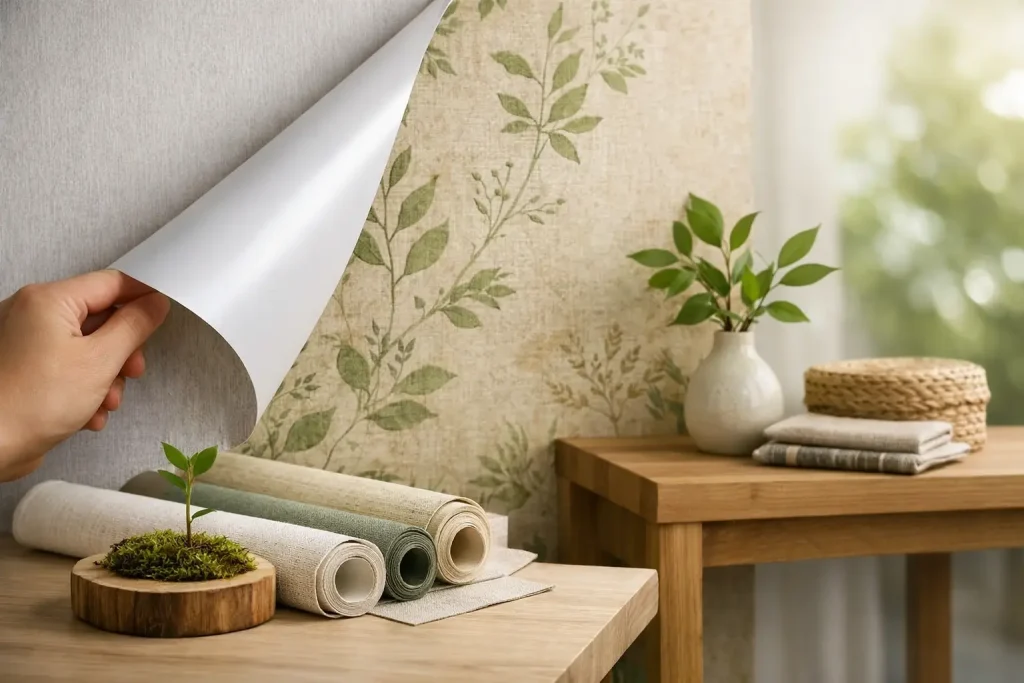
PVC wallpaper still creates the same headaches on live projects – awkward installs, wall damage on removal, single-use waste, and a finish that can work against the space rather than with it. If you are looking for a sustainable alternative to PVC wallpaper, the question is not just what looks better on day one. It is what performs better across installation, changeover, removal, and reuse.
For print providers, fit-out teams, designers, and facilities managers, that lifecycle view matters. A wallcovering can look cost-effective when ordered by the roll, then become expensive once labour, substrate prep, adhesive issues, failed panels, and redecoration are added in. Sustainability and operational efficiency often point in the same direction. Materials that install faster, remove cleanly, and avoid damage usually reduce waste as well.
What makes a sustainable alternative to PVC wallpaper?
A genuinely sustainable specification is not defined by one claim on a data sheet. It comes from the full picture – what the material is made from, how it is printed, how long it lasts, whether it can be repositioned instead of replaced, and what happens to the wall underneath when the graphic comes down.
That is where many traditional PVC wallcoverings fall short. PVC has long been used because it is familiar and widely available, but familiarity is not the same as best practice. In commercial interiors, retail campaigns, exhibitions, museums, hospitality settings, and public environments, the pressure is usually on flexibility as much as durability. If the graphic needs to change seasonally, move with a campaign, or come off a protected surface without a remedial works bill, a rigid, adhesive-heavy wallcovering starts to look outdated very quickly.
A more sustainable route is a peel-and-stick fabric media designed for clean application and clean removal. That changes the conversation from decorative surface only to full project performance.
Why PVC wallpaper often underperforms in real spaces
On paper, PVC wallpaper can seem like a practical default. On site, the trade-offs are harder to ignore. Installation is typically less forgiving, especially where walls are not perfectly flat or where downtime is limited. Removal can be slow and messy. Adhesive residue, lifted paint, damaged plaster, and the need to redecorate are common pain points.
Those issues are not just cosmetic. They affect programme, labour cost, and confidence in temporary or evolving interior schemes. A retail team planning frequent campaign updates, or a museum managing sensitive surfaces, needs more than a nice print result. They need predictability.
There is also the waste factor. If a wallcovering is effectively single use, every refresh creates another disposal problem. Where the material cannot be repositioned during installation, errors also mean more wasted print. For professionals under pressure to reduce environmental impact without compromising finish quality, that is no longer a small detail.
Fabric media as a practical, sustainable alternative to PVC wallpaper
A woven polyester self-adhesive fabric offers a different set of advantages. Instead of relying on aggressive adhesion and difficult removal, it is built around flexibility. It can be applied, peeled back, repositioned, and removed cleanly without leaving residue or damaging the surface when used correctly.
That matters because sustainable choices need to work in the real world. A product is not greener in any meaningful way if it causes failures on site, has to be replaced early, or forces a full repaint after every campaign. In many commercial and domestic settings, the most sustainable material is the one that protects the substrate, extends the life of the surface, and supports repeated use.
This is why fabric wall graphics have become a smarter specification for short-term promotions, semi-permanent décor, branded interiors, exhibitions, heritage spaces, and venue graphics. They reduce install risk, shorten changeover time, and cut the hidden waste that comes from damaged walls and failed applications.
Where a sustainable alternative to PVC wallpaper delivers the biggest gains
The strongest case for switching appears in spaces that change often or cannot tolerate disruption. Retail displays are an obvious example. Seasonal promotions, window campaigns, and feature walls need impact, but they also need speed. A material that can go up quickly and come down cleanly supports that rhythm far better than a traditional PVC wallcovering.
In hospitality and workplace interiors, the balance is slightly different. Here, the priority is often finish quality combined with easy future updates. Décor schemes evolve. Branding changes. Refurbishment cycles tighten. If the wall graphic can be refreshed without damaging painted surfaces or creating a multi-trade repair job, the long-term value is clear.
Museums, galleries, schools, childcare settings, and heritage properties have even less tolerance for aggressive adhesives and surface damage. Protected walls and sensitive substrates require a lighter-touch solution. In these environments, residue-free removability is not a nice extra. It is often the deciding factor.
What to look for when specifying an alternative
Not all non-PVC options perform the same way. Some sustainable claims sound strong until the product meets a textured wall, a large panel install, or a demanding removal schedule. The right specification depends on the surface, the timescale, and whether the graphic needs to be reused.
Start with removability. Clean removal without residue should be proven, not assumed. If the wallcovering leaves adhesive behind or lifts the finish, any sustainability argument weakens immediately.
Then look at repositionability. A material that can be lifted and reapplied during install reduces waste, speeds fitting, and lowers the risk of expensive errors. For installers and print teams, that is a direct operational advantage.
Surface protection is another key point. A better wall graphic does not just decorate the substrate. It helps preserve it. That is particularly valuable on painted walls, display panels, exhibition builds, and interior surfaces that need to stay in good condition through multiple campaigns.
Opacity and finish also matter. In refurbishments and branded environments, the material needs to cover existing colours or graphics where required and deliver a premium printed appearance. A sustainable specification still has to look right.
Performance matters more than green claims alone
This is where many buying decisions become clearer. Sustainability should not sit apart from performance. It should be visible in performance.
A fabric media that removes cleanly, repositions repeatedly, and can be reused already solves several waste problems at once. It cuts spoilage during fitting. It reduces the need for replacement graphics when panels are misaligned. It avoids the paint repair and patching that often follow PVC removal. It also supports repeated campaign use where appropriate, reducing the volume of material consumed over time.
For trade users, that is a more useful measure than broad environmental language. A material either makes the job cleaner and more efficient, or it does not. A wallcovering either protects the substrate and supports repeat use, or it becomes another source of waste.
Phototex sits firmly in that performance-led category. As a 100% polyester self-adhesive fabric, it is designed to install simply, remove without residue, reposition repeatedly, and protect surfaces across a wide range of interior applications. That combination is exactly why it is specified as a modern alternative to traditional vinyl and PVC-based wallcoverings.
The trade-offs to consider
No material is universal, and the right choice still depends on the job. If you need a very long-term installation in a harsh environment, substrate condition, humidity, cleaning regimes, and wall texture all need to be assessed properly. Some surfaces require higher tack solutions. Others benefit from blockout opacity or a more forgiving printable face.
That does not weaken the case for fabric media. It simply means specification should be honest. The best sustainable alternative to PVC wallpaper is the one matched correctly to the environment and expected lifespan.
For most interior décor, branded wall graphics, exhibitions, events, and temporary or semi-permanent displays, the balance is now hard to ignore. Clean removal, reusability, fast installation, and reduced risk on the wall underneath are not fringe benefits. They are the new baseline for smarter projects.
When wall graphics need to do more than cover a surface, PVC wallpaper starts to look like yesterday’s answer. A modern fabric-based media gives you more control over installation, more flexibility over time, and less waste at every stage. That is not just a better sustainability story. It is a better way to run the job.
 English
 French