
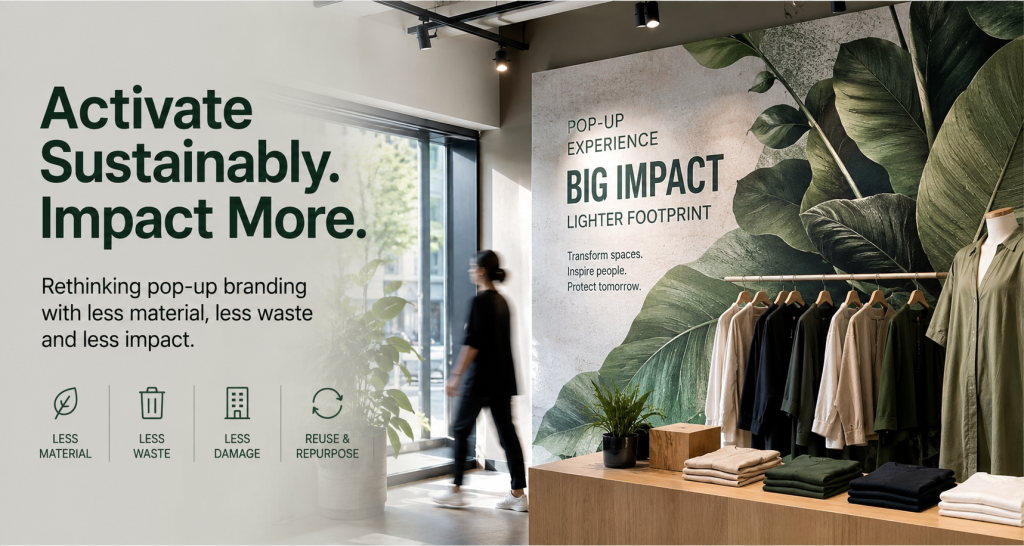
The Sustainable Future of Brand Activation: Less Material, Less Waste, More Impact
How brands can make temporary experiences more sustainable — without compromising creativity, performance or impact
Pop-ups, activations, exhibitions and temporary retail environments have become some of the most powerful ways for brands to create attention.
They allow a brand to appear somewhere unexpected, create a physical experience around a campaign, test a new concept, launch a product or transform an existing environment for a limited period of time.
But there is an uncomfortable contradiction at the heart of temporary marketing.
The shorter the campaign, the harder it can be to justify the materials used to create it.
A campaign may exist for days or weeks, yet the conventional materials used to build it can involve boards, PVC-based films, plastics, adhesives, coatings, fixings, specialist installation and removal. At the end of the activation, much of that material has little useful life left.
The result is a marketing model in which a temporary message can create a surprisingly permanent environmental footprint.
There is another way to think about it.
From temporary product to temporary system
The opportunity isn’t simply to replace one graphic material with another.
It is to rethink the entire lifecycle of a temporary brand experience.
How much material is required?
How much needs to be transported?
How much installation is involved?
Does the installation damage the building or surface?
How much specialist labour is required?
What happens when the campaign ends?
Can the graphic be removed cleanly?
Can the surface immediately be used for something else?
Can the graphic itself be repositioned, stored or reused?
And perhaps most importantly:
Do we really need to construct something permanent to create a temporary experience?
Phototex peel-and-stick woven fabric provides an example of what becomes possible when these questions are considered together rather than individually.
The material becomes part of a system for temporary visual transformation.
Activation doesn’t have to mean construction
Traditional temporary branding often follows a familiar sequence:
Design → manufacture → transport → construct → install → campaign → dismantle → dispose.
Every stage consumes resources.
A more circular approach can look very different:
Design → print → apply → activate → remove → reuse, reposition or replace.
The difference is fundamental.
Instead of building a temporary environment around the graphic, the graphic itself can become the means of transforming the existing environment.
A wall can become a campaign.
A retail space can become a launch environment.
A conference room can become a branded experience.
A window can become an advertising surface.
An exhibition stand can change from one event to the next.
The underlying architecture remains.
The visual environment changes.
That distinction has significant implications for material consumption.
Less material can mean more flexibility
One of the most compelling sustainability opportunities comes from simply asking whether a temporary installation needs all the physical components traditionally associated with it.
If a wall can become the display surface, perhaps a temporary construction doesn’t need to be built in front of it.
If an existing surface can carry the graphic, perhaps additional boards, panels, frames and fixings aren’t necessary.
If a graphic can be removed without damaging the surface, perhaps restoration isn’t required afterwards.
If it can be repositioned or reused, perhaps the next campaign doesn’t need to start from zero.
This is where woven fabric becomes more than a substrate.
It becomes an enabling layer between the brand and the built environment.
The carbon conversation is bigger than the material
Sustainability discussions can become overly focused on the specification of an individual product.
Is it PVC-free?
Is it recyclable?
What is the material composition?
What is the weight?
These questions matter, but they are only part of the picture.
For temporary applications, the larger question is often:
What does the entire installation require?
A lower-impact material can still be part of a high-impact installation if it requires extensive supporting structures, specialist labour, multiple transport movements and disposal at the end.
Conversely, a system that allows an existing surface to be transformed directly can potentially reduce impacts across several stages of the lifecycle.
Less supporting material.
Less construction.
Less transport.
Less installation.
Less removal.
Less surface repair.
Less waste.
And, where graphics can be repositioned or reused, potentially fewer new graphics being produced for every activation.
That is why the sustainability proposition of Phototex should not be reduced to a claim about a roll of fabric.
The real opportunity lies in what the fabric enables.
Protecting the asset underneath
There is another environmental consideration that is often overlooked: the surface itself.
Retail stores, hotels, offices, galleries, museums, exhibition venues and commercial buildings are valuable assets.
Temporary branding shouldn’t create unnecessary damage to them.
Conventional installation methods can leave behind adhesive residue, holes, fixing damage or the need for repainting and refurbishment.
That creates another cycle of materials, labour and disruption.
A removable peel-and-stick fabric approach can change that relationship.
Instead of attaching a temporary campaign through permanent intervention, the campaign can become a temporary layer over the existing environment.
The building remains.
The brand experience changes.
And when the campaign is finished, the environment can return to its previous state.
Sustainability without compromising the creative brief
Perhaps the biggest barrier to sustainable marketing isn’t technology.
It is the fear of compromise.
Design teams don’t want sustainability to mean:
less visual impact
fewer creative possibilities
difficult installation
inferior print quality
complicated removal
restricted applications
higher project risk
That is why the most effective sustainable solution is not necessarily the one with the strongest environmental story.
It is the one that makes the better environmental choice easier to specify.
If designers, agencies, printers and installers can use a material within familiar creative workflows, print it using existing wide-format technology, apply it efficiently and remove it without significant disruption, sustainability becomes part of the process rather than an additional task.
That is a much more powerful proposition.
The opportunity for brands
For brands, this creates a new way to think about activation.
Instead of asking:
“What temporary structure should we build for this campaign?”
ask:
“How can we transform the existing environment using the minimum amount of new material?”
Instead of:
“What happens to everything when the campaign finishes?”
ask:
“What can be removed, reused, repositioned or repurposed?”
And instead of measuring sustainability only at the point of purchase, consider the whole activation:
materials + manufacture + transport + installation + operation + removal + disposal + reinstatement.
That is where meaningful reductions can emerge.
A more intelligent model for pop-ups
The future of temporary branding doesn’t necessarily require less ambition.
It requires less unnecessary infrastructure.
A brand can still create the dramatic reveal.
It can still transform a retail environment.
It can still create an immersive event.
It can still deliver a spectacular exhibition.
It can still cover an entire wall with a powerful photographic image.
But the physical intervention required to achieve that experience can become considerably lighter.
This is the promise of a system-led approach to temporary visual communication.
Keep the building. Change the experience. Reduce the intervention.
From disposable campaign to reusable capability
The most interesting shift may ultimately be cultural.
Brands are accustomed to thinking about campaigns as individual projects.
Design.
Print.
Install.
Remove.
Repeat.
A more sustainable approach is to think about the physical environment as a reusable brand platform.
The same retail store can host multiple campaigns.
The same exhibition space can become completely different environments.
The same conference centre can be transformed for different clients.
The same hotel can change its visual identity for seasonal events.
The same office can evolve with its brand.
The infrastructure doesn’t need to be rebuilt every time.
The visual layer simply changes.
That is a much closer approximation to a circular model.
The best sustainable solution is the one that doesn’t feel like a compromise
Phototex is therefore best understood not simply as a peel-and-stick printable fabric.
It is an example of a broader principle:
Use the existing environment. Add only what is necessary. Make the intervention temporary. Remove it cleanly. Reuse what can be reused.
For designers, this can mean greater freedom rather than restriction.
For brands, it can mean more agile activation.
For property owners, less damage and disruption.
For printers and installers, a new range of applications.
And for the environment, potentially fewer materials moving through the entire temporary-display lifecycle.
The goal isn’t simply to make temporary marketing less bad.
It is to design a better system from the beginning.
Activation should create an impression — not a pile of waste.
The next generation of brand experiences can be temporary without being disposable, or wasteful, dramatic without being destructive, and sustainable without compromising the creative ambition that made the activation worth doing in the first place.
 English
 French