
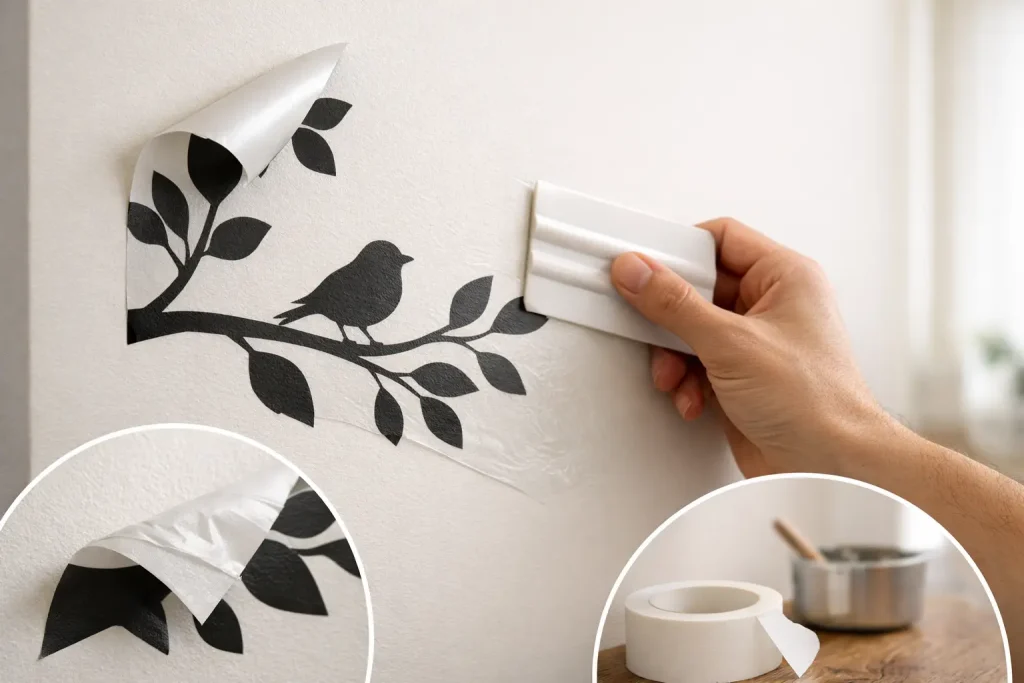
A wall graphic can look perfect at handover, then begin lifting at the corners before the venue opens. That is why do wall decals curl is not a minor decorative question for print providers, installers and facilities teams. Curling edges can compromise the finish, collect dust, create a trip hazard at low level and lead to an avoidable reprint or return visit.
The good news is that curling is usually diagnosable. It is rarely one mysterious fault. More often, it is the result of the wall, the material, the environment and the installation method working against one another. Identify the real cause before applying a quick fix, and the next installation will be faster, cleaner and more reliable.
Why do wall decals curl after installation?
Wall decals curl when the adhesive bond at the edge is weaker than the forces pulling the graphic away from the surface. Those forces may come from a difficult substrate, trapped stress in the media, changing temperature or moisture, poor edge contact, or a combination of all four.
Edges are the first place to fail because they have the least support. A graphic can appear secure across its main area while a small amount of tension, contamination or surface texture prevents the adhesive from making full contact around the perimeter. Once an edge lifts, air and dust can work underneath it, making the problem more visible and harder to reverse.
The material also matters. Some self-adhesive films naturally retain a tendency to return to their rolled shape. This is often called material memory. A stiff film applied straight from a tightly wound roll can place continuous tension on its own edges. On a demanding wall, that tension may be enough to start a curl.
The wall is often the real problem
Not every painted wall is a suitable graphic surface. Paint may look sound but still be dusty, chalky, greasy or coated with cleaning residues. In retail, hospitality and public venues, walls are frequently cleaned with products that leave a silicone, polish or detergent film behind. Adhesive cannot bond properly to a barrier it cannot reach.
Fresh paint is another regular cause. Paint can feel dry within hours while it continues to cure and release moisture or solvents for much longer. Applying graphics too soon can weaken adhesion and, in some cases, put the paint finish at risk on removal. A sound, fully cured, clean and dry surface gives any self-adhesive media its best chance of performing as intended.
Low-energy, stain-resistant and highly washable paints deserve particular caution. Their surface chemistry is designed to repel marks and moisture. It can also make them harder for conventional pressure-sensitive adhesives to grip. Textured paint, blown vinyl wallcovering, unfinished plaster, loose paper and flaky coatings create further variables. A material that works on smooth painted plasterboard may not work on a rough, porous feature wall.
Temperature and humidity change the installation conditions
Graphics installed in a cold loading bay, an unheated gallery or a shopfront exposed to winter draughts may not achieve a strong initial bond. Adhesives generally need a sensible application temperature to wet out properly against the surface. If the wall or material is cold, the installer may press it down, but the adhesive has not fully conformed to the substrate.
Heat can cause a different problem. Sun-facing walls, radiator zones and high-output lighting can warm the graphic repeatedly. The face material expands and contracts while the adhesive holds it in place. If the media is stiff, over-stretched or not suited to the environment, the edges carry the strain first.
Humidity has a role too. Moisture can affect porous walls, newly decorated areas and spaces with poor environmental control. Bathrooms, leisure facilities, kitchens and entrance areas need substrate-specific assessment rather than a one-material-fits-all assumption.
Installation issues that cause decal edges to lift
Even the right media can fail if it is fitted under tension. Pulling a decal hard to remove a wrinkle, applying large panels too quickly, or forcing the material around an uneven area creates stored stress. It may hold temporarily, then relax over the next few hours or days and pull away at the corners.
Pressure is equally important. Adhesive needs firm, even contact with the wall, particularly at the perimeter and around cut details. Light hand smoothing can leave tiny unbonded channels. Use the appropriate application tool and work methodically from the centre outwards, maintaining contact without stretching the graphic.
Corners, narrow points and intricate contour cuts are naturally vulnerable. A long, sharp point has less adhesive area than a broad square corner, so it is more likely to lift on a textured or difficult wall. Where the design allows, round off sharp corners and avoid unnecessarily fine edge details. This small production decision can reduce failures significantly.
Panel overlaps also need care. If graphics are installed with misaligned overlaps or an overlap is pulled tight, the tension travels along the panel edge. For full-wall installations, a stable media with predictable handling characteristics is a practical advantage, especially where installers need to align large printed sections quickly.
How to prevent wall decals from curling
Prevention begins before print. Ask what surface is being covered, when it was painted, how it is cleaned, whether it is smooth or textured, and what conditions the space experiences during installation and use. A sample test is not a delay. It is a low-cost way to prevent a site revisit, damage dispute or wasted production run.
Allow the media to acclimatise in the installation environment rather than taking it directly from a cold vehicle to the wall. Keep rolls stored correctly, avoid crushing their edges and do not leave them in extreme heat. Letting the material rest flat where practical can reduce curl caused by tight roll memory.
Prepare the wall using the cleaning method appropriate for the substrate and the site. The objective is simple: remove dust, grease and residues, then allow the surface to dry completely. Do not apply over loose paint, damp patches, mould, damaged wallcovering or visibly chalky finishes and hope the graphic will hold it together. Adhesive media follows the strength of the surface beneath it.
During fitting, avoid stretching the material. Apply in manageable sections, use controlled pressure, and give every edge deliberate attention. Recheck corners and cut shapes before leaving site, particularly around doors, radiators, air-conditioning outlets and areas exposed to regular handling.
For demanding surfaces, specify the media rather than treating all wall films as interchangeable. A product designed for smooth, temporary décor is not automatically the right choice for textured walls, floors or more challenging indoor and outdoor work. The cost of selecting the correct adhesive and fabric construction is usually far lower than the cost of replacement graphics, access equipment and labour.
Can a curled wall decal be fixed?
Sometimes. If the edge has only just lifted and both the wall and adhesive are clean, dry and undamaged, it may be possible to carefully reposition and reapply the graphic with firm pressure. This depends on the material and on whether the adhesive has picked up dust. Once contamination sits on the adhesive, pressing harder is unlikely to produce a lasting repair.
Do not use household glues, tape or aggressive adhesive sprays as a default rescue method. They can stain the wall, create visible edge marks and defeat the purpose of using a removable graphic. They also make future removal more difficult, potentially turning a simple display update into a redecoration job.
If several edges are lifting, stop treating each corner as an isolated issue. Check the surface preparation, paint condition, room temperature, installation tension and material specification. Widespread failure points to an underlying compatibility problem, not a single weak corner.
A more reliable approach for changing interiors
For campaigns, exhibitions, retail refreshes and temporary décor, the best result comes from a graphic system designed around the whole lifecycle: application, repositioning, clean removal and reuse where appropriate. Fabric-based self-adhesive media can reduce the stiffness and handling issues associated with traditional PVC wall films, while protecting surfaces that cannot afford damage.
Phototex provides a woven 100% polyester self-adhesive fabric option for applications where clean, residue-free removal and repeated repositioning matter. Its Original, OPAQUE and EX options allow installers to match the material to smooth walls, high-opacity panel joins or more demanding textured surfaces, rather than forcing one product into every environment.
A curled decal is a signal, not just a cosmetic defect. Read it early, test the surface, specify for the conditions and install without tension. The result is a graphic that stays sharp while it is needed, then comes away cleanly when the space needs to change.
 English
 French